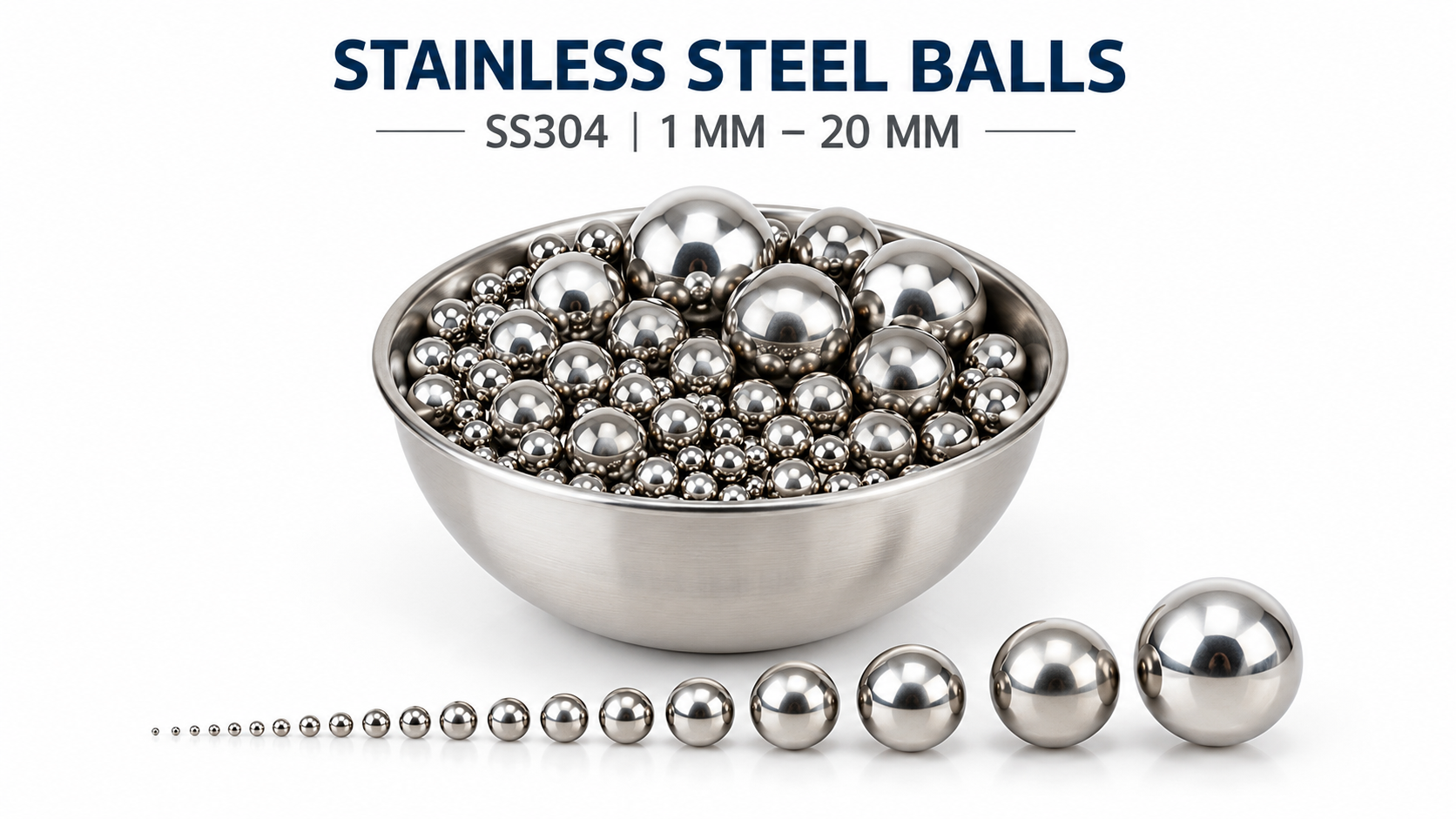
Stainless steel balls are precision spherical components used in bearings, mechanical assemblies, industrial machinery, automation systems, engineering equipment, and various motion-related applications. SS304 stainless steel balls are widely preferred where corrosion resistance, durability, smooth movement, and reliable mechanical performance are important. Their spherical shape and availability in a wide range of diameters make them useful for applications requiring accurate fit and consistent contact between components. This product range offers numerous sizes from 1 MM to 20.63 MM, including both standard and closely specified fractional diameters. Whether required for bearing components, replacement parts, manufacturing, maintenance, or mechanical assemblies, selecting the correct stainless steel ball size and specification is essential for dependable performance.
What Are Stainless Steel Balls?
Stainless steel balls are spherical metal components manufactured for use in mechanical, industrial, engineering, and precision applications. Their round shape allows them to roll, rotate, provide point contact, or act as a moving or positioning component within an assembly.
SS304 stainless steel balls are manufactured using 304-grade stainless steel, a commonly used stainless steel material known for its corrosion resistance and versatility. The material makes these balls suitable for many applications where ordinary steel components may require additional protection against moisture or corrosion.
The performance of a stainless steel ball depends on several factors, including its material, diameter, surface finish, dimensional consistency, spherical accuracy, and the application in which it is being used.
For this reason, buyers should select stainless steel balls based on the technical requirements of the equipment rather than choosing a size only by visual appearance.
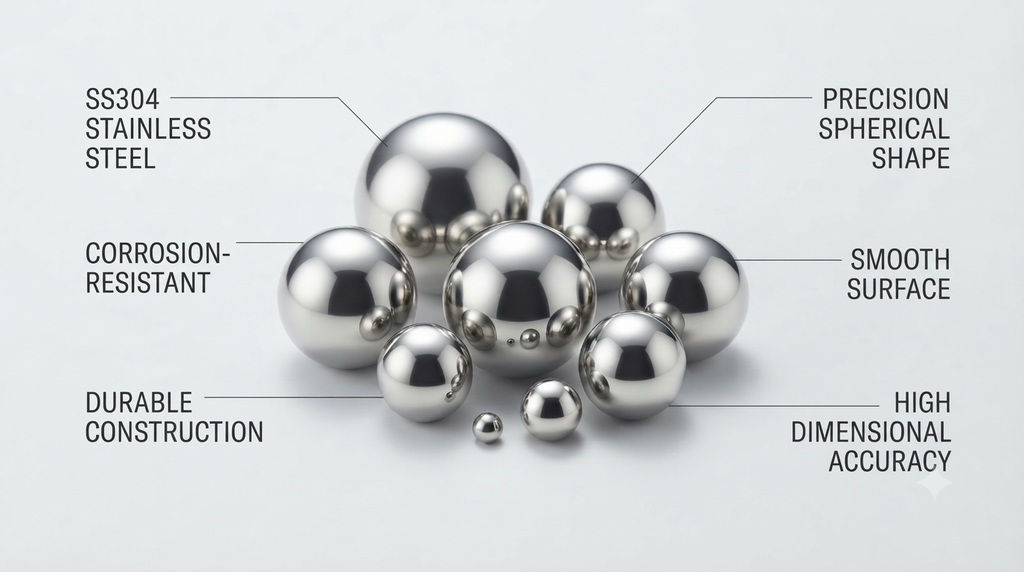
Features of SS304 Stainless Steel Balls
The following features make SS304 stainless steel balls suitable for a broad range of compatible mechanical and industrial applications.
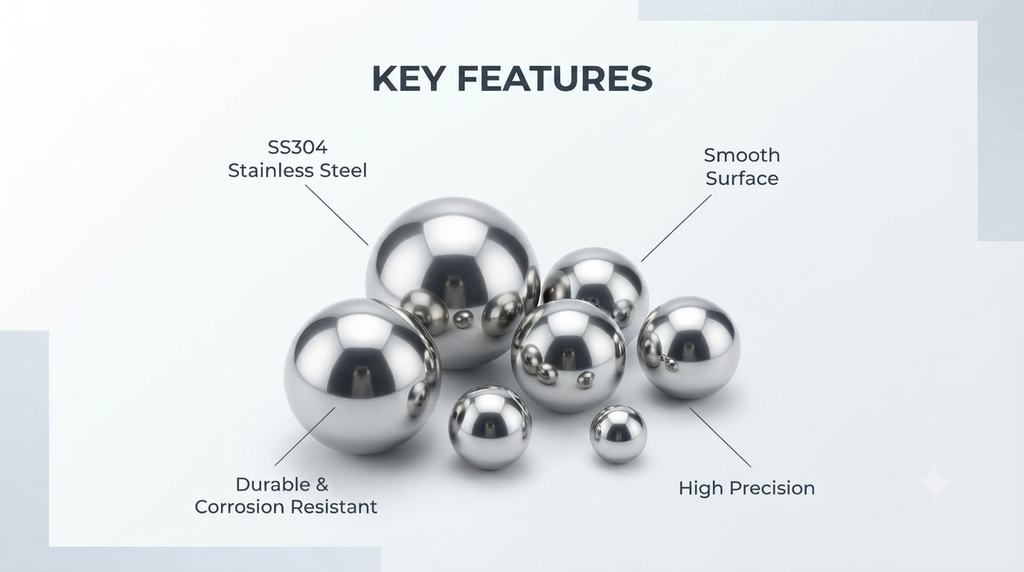
1. SS304 Stainless Steel Construction
These balls are designed using SS304 stainless steel, providing a combination of corrosion resistance, durability, and versatility for general industrial applications.
2. Smooth Spherical Design
The spherical shape allows the balls to provide controlled contact and movement in suitable mechanical systems. A smooth surface can also support consistent rolling performance.
3. Wide Size Selection
The product is available in numerous diameters ranging from 1 MM to 20.63 MM, allowing buyers to select a size according to their specific application requirements.
4. Multiple Fractional Sizes
In addition to common whole-number diameters, the range includes closely specified sizes such as 3.95 MM, 3.96 MM, 3.97 MM, 3.98 MM, 3.99 MM and several other fractional measurements.
5. Corrosion-Resistant Material
SS304 offers good resistance to corrosion in many general environments, making it useful where exposure to moisture or humidity may be a consideration.
6. Suitable for Mechanical Applications
The balls can be used in compatible bearing, mechanical, automation, engineering, and industrial assemblies.
7. Consistent Spherical Form
A consistent spherical shape is important for applications involving rolling, rotation, positioning, or point contact.
8. Useful for Replacement Requirements
The extensive range of available diameters makes these stainless steel balls useful for maintenance and replacement requirements where a particular ball size is needed.
Benefits of Stainless Steel Balls
Choosing the right stainless steel ball can provide several practical benefits for industrial and mechanical applications.
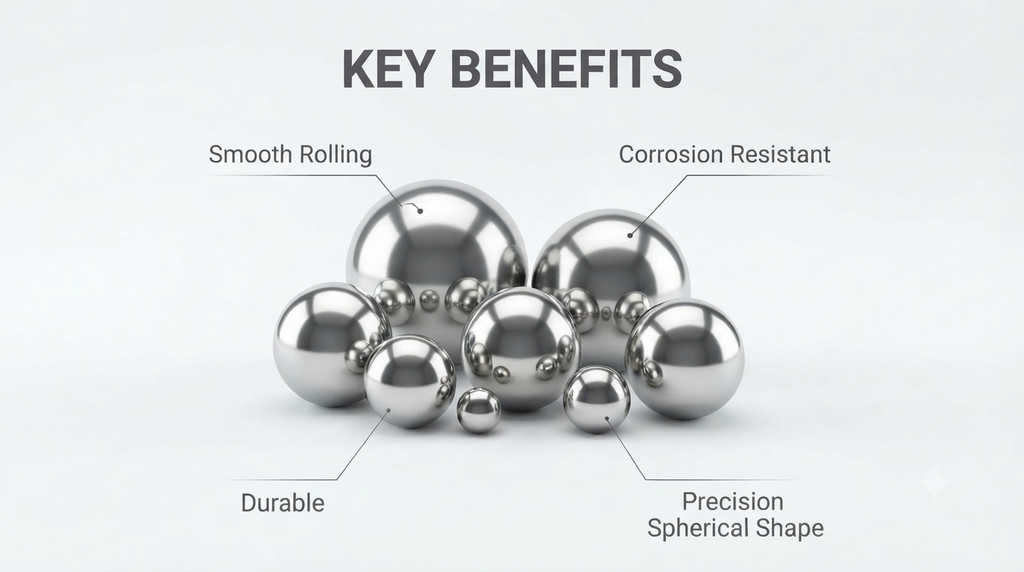
Corrosion Resistance
One of the key benefits of SS304 stainless steel is its resistance to corrosion compared with many ordinary carbon steel materials. This makes SS304 balls suitable for many applications where moisture or humid conditions may be present.
However, corrosion resistance depends on the actual operating environment. Applications involving aggressive chemicals or extreme conditions should be evaluated separately.
Reliable Mechanical Performance
Stainless steel balls are designed to provide dependable performance in suitable mechanical applications. Their spherical shape supports rolling, movement, contact, or positioning depending on the equipment design.
Long-Term Usability
The combination of stainless steel construction and appropriate surface characteristics can make these balls suitable for repeated use in compatible applications.
Correct sizing and proper application are important for achieving the expected service performance.
Easy Size Selection
With a broad selection of diameters, buyers can select a ball according to the requirements of their equipment rather than being restricted to only a few common sizes.
Suitable for Industrial Procurement
The availability of numerous sizes makes stainless steel balls useful for manufacturers, maintenance departments, engineering companies, and industrial buyers looking for replacement or production components.
Versatile Applications
SS304 stainless steel balls can be used across multiple industries and mechanical systems. Their applications can range from bearing-related components to automation, machinery, engineering assemblies, and suitable valve mechanisms.
Applications of SS304 Stainless Steel Balls
Stainless steel balls have many possible applications depending on their size, specifications, surface characteristics, and the design of the equipment.
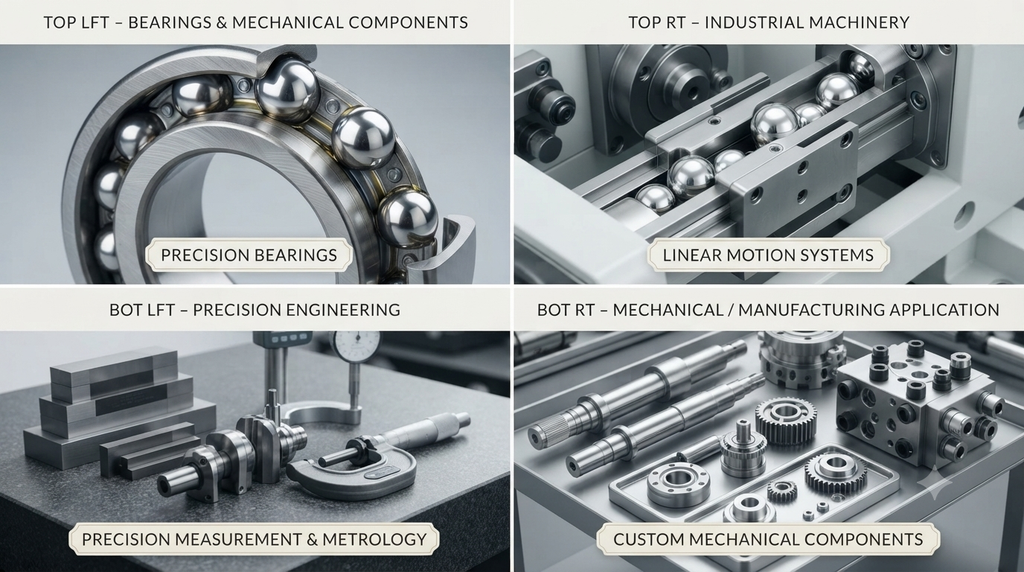
1. Bearings and Bearing Assemblies
One of the most common applications of steel balls is in bearing assemblies. Ball bearings use spherical rolling elements between raceways to facilitate rotational movement.
The correct diameter is extremely important because bearing components are manufactured according to specific dimensional requirements.
SS304 balls may be suitable for compatible bearing applications where stainless steel and corrosion resistance are required.
2. Mechanical Equipment
Stainless steel balls can be incorporated into mechanical equipment as rolling, moving, positioning, or contact components.
They may be used in assemblies where controlled movement between surfaces is required.
3. Industrial Machinery
Industrial machinery can use spherical metal components for various mechanical functions. Stainless steel balls can be considered for suitable machinery applications where durability and corrosion resistance are important.
4. Automation Equipment
Automation and motion-control equipment may use small spherical components in mechanical assemblies. The availability of small diameters such as 1 MM, 1.5 MM, 1.58 MM, 1.6 MM and 1.8 MM provides options for applications requiring smaller ball sizes.
5. Engineering Assemblies
Engineering and manufacturing applications may require stainless steel balls as part of custom mechanical assemblies, equipment, fixtures, or specialized components.
6. Replacement Components
Maintenance teams may require replacement balls for existing mechanical systems. Having access to multiple diameters can simplify the process of finding a compatible replacement size.
7. Suitable Valve Applications
Certain valve mechanisms incorporate spherical components. Where applicable, stainless steel balls can be selected according to the valve’s dimensional, material, pressure, temperature, and operating requirements.
The exact suitability should always be confirmed before use.
8. Manufacturing Applications
Manufacturers may use stainless steel balls as components within different production assemblies. The required ball diameter should be selected according to engineering drawings or equipment specifications.
9. Motion and Positioning Systems
Spherical components can be used for controlled movement or positioning in suitable mechanical systems. Their effectiveness depends on the design and operating conditions of the assembly.
10. Industrial Maintenance
Maintenance departments can keep different sizes available for repair and replacement requirements. A wide size range can help reduce delays when a particular component needs replacement.
Stainless Steel Ball Size Variations
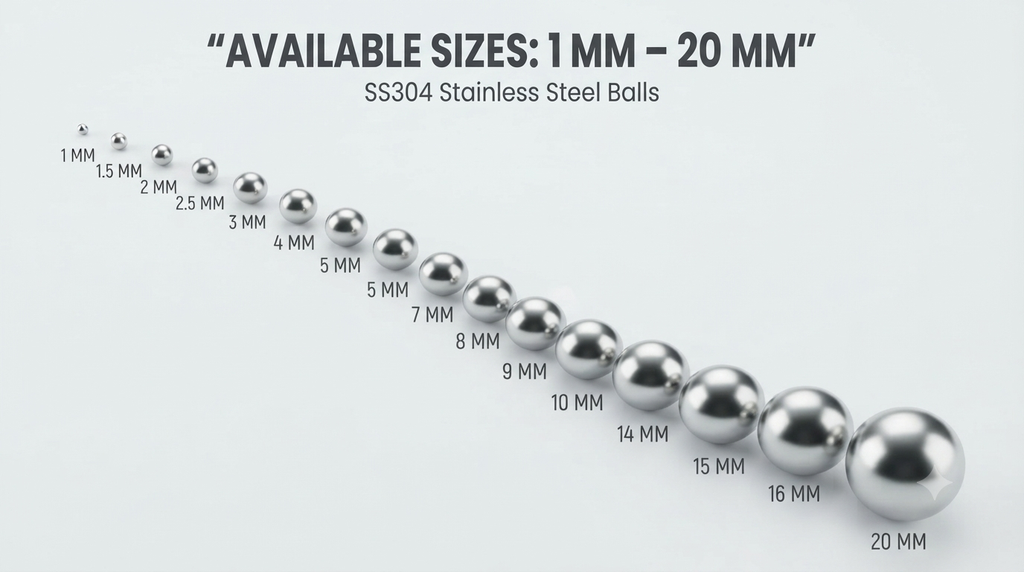
This SS304 stainless steel ball range includes an extensive selection of diameters.
Available Variations
1 MM, 1.5 MM, 1.58 MM, 1.6 MM, 1.8 MM, 2.24 MM, 2.36 MM, 2.37 MM, 2.38 MM, 2.39 MM, 2.5 MM, 2.6 MM, 2.77 MM, 3 MM, 3.1 MM, 3.11 MM, 3.13 MM, 3.14 MM, 3.16 MM, 3.17 MM, 3.18 MM, 3.19 MM, 3.20 MM, 3.22 MM, 3.50 MM, 3.51 MM, 3.52 MM, 3.53 MM, 3.7 MM, 3.91 MM, 3.95 MM, 3.96 MM, 3.97 MM, 3.98 MM, 3.99 MM, 4 MM, 4.36 MM, 4.5 MM, 4.74 MM, 4.75 MM, 4.76 MM, 4.77 MM, 4.78 MM, 4.9 MM, 5 MM, 5.1 MM, 5.2 MM, 5.3 MM, 5.5 MM, 5.55 MM, 5.56 MM, 5.7 MM, 5.8 MM, 5.9 MM, 5.95 MM, 6 MM, 6.1 MM, 6.2 MM, 6.3 MM, 6.33 MM, 6.34 MM, 6.35 MM, 6.36 MM, 6.37 MM, 6.38 MM, 6.39 MM, 6.4 MM, 6.41 MM, 6.42 MM, 6.5 MM, 7 MM, 7.13 MM, 7.14 MM, 7.15 MM, 7.20 MM, 7.50 MM, 7.92 MM, 7.93 MM, 7.95 MM, 7.96 MM, 8 MM, 8.73 MM, 9 MM, 9.42 MM, 9.52 MM, 9.54 MM, 10 MM, 10.31 MM, 11.11 MM, 11.90 MM, 12 MM, 12.7 MM, 12.75 MM, 13.49 MM, 14.28 MM, 15 MM, 16 MM, 16.66 MM, 17 MM, 17.46 MM, 18 MM, 18.25 MM, 19 MM, 19.84 MM, 20 MM, 20.63 MM.
This extensive variation range provides options for both small mechanical assemblies and larger industrial requirements.
How to Choose the Right Stainless Steel Ball?
Selecting the correct stainless steel ball requires more than simply choosing a diameter.
Check the Required Diameter
Always verify the required diameter using the equipment specification, engineering drawing, bearing specification, or measurement of the existing component.
Check the Material
Confirm that SS304 is suitable for the intended environment and application.
Understand the Application
Identify whether the ball is required for a bearing, mechanical assembly, automation system, valve, industrial machine, or replacement application.
Consider Operating Conditions
Review factors such as moisture, humidity, temperature, chemicals, load, speed, and frequency of movement.
Check Compatibility
The ball should be compatible with the mating components, including raceways, housings, shafts, cages, mechanisms, or other contact surfaces.
Quality Considerations When Buying Stainless Steel Balls
Quality is an important consideration when purchasing stainless steel balls, particularly for bearing and mechanical applications.
Material Grade
Verify that the balls are manufactured from the required stainless steel grade. For this product, SS304 is the specified material.
Diameter Accuracy
The diameter should match the requirement of the intended application. A small difference in size can affect the fit and performance of a precision mechanical assembly.
Spherical Accuracy
A stainless steel ball should maintain a consistent spherical form for applications requiring controlled rolling, movement, or contact.
Surface Finish
Surface smoothness can be important in bearing and mechanical applications. A suitable surface finish can support smooth interaction between the ball and mating components.
Consistency Across the Product
For applications requiring multiple balls in the same assembly, dimensional and surface consistency can be an important consideration.
Application Compatibility
Even a high-quality stainless steel ball may not be suitable for every application. Buyers should ensure that the material, size, surface characteristics, load capacity, and environmental requirements are appropriate.
Proper Storage and Handling
Stainless steel balls should be handled and stored appropriately to help protect their surface and prevent contamination, scratches, or damage before installation.
Why Choose Stainless Steel Balls for Industrial Use?
Industrial applications often require small components that can perform reliably over repeated operating cycles. Stainless steel balls offer a practical combination of material performance and versatility for many compatible applications.
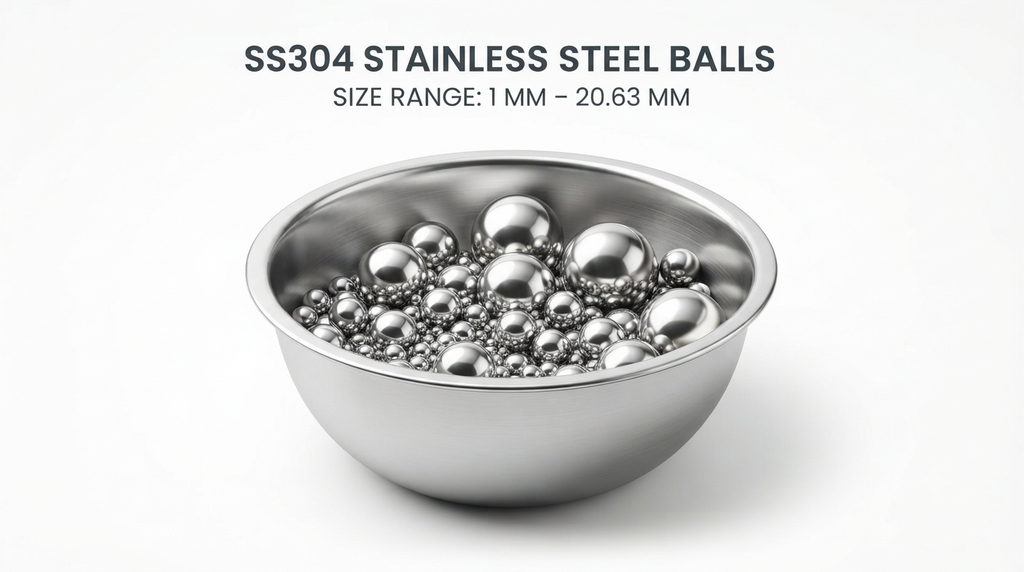
SS304 provides corrosion resistance and is suitable for many general industrial environments. The spherical design supports applications involving rolling, rotation, contact, or positioning.
Another important advantage is the wide selection of available sizes. Industrial equipment does not always use only standard whole-number dimensions. Some assemblies require closely specified sizes such as 4.74 MM, 4.75 MM, 4.76 MM, 4.77 MM, 4.78 MM, or 6.33 MM through 6.42 MM.
Having access to these variations can be particularly useful for maintenance teams, manufacturers, and engineering buyers.
Buy Stainless Steel Balls Online
For manufacturers, engineers, maintenance professionals, and industrial buyers, selecting the correct stainless steel ball starts with identifying the required material and diameter.
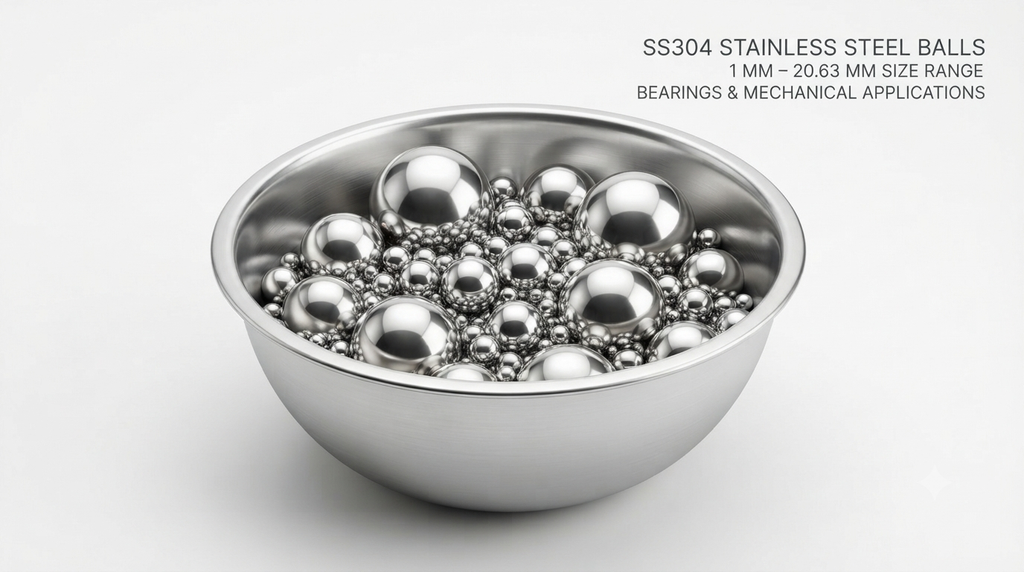
This SS304 stainless steel ball range provides numerous size options from 1 MM to 20.63 MM, helping buyers find suitable options for different mechanical and industrial requirements.
If you need stainless steel balls for bearings, machinery, mechanical assemblies, automation, engineering, or replacement applications, buy stainless steel balls online after confirming the required specifications.
Buy SS304 Stainless Steel Balls from Website
For regular industrial procurement and replacement requirements, buyers can review the available SS304 stainless steel ball sizes and select the required diameter according to their application.
From small-diameter balls to larger sizes, the extensive variation range is suitable for businesses looking for stainless steel spherical components for compatible industrial and mechanical applications.
If you know the required diameter and material specification, buy SS304 stainless steel balls from the website and select the appropriate size for your application.
Conclusion
SS304 stainless steel balls are versatile spherical components used in bearings, mechanical assemblies, industrial machinery, automation equipment, engineering applications, maintenance, and other compatible systems.
Their key advantages include SS304 stainless steel construction, corrosion resistance, smooth spherical form, dimensional options, and versatility across different mechanical applications. The extensive range of sizes from 1 MM to 20.63 MM also provides buyers with numerous options for standard and closely specified requirements.
When purchasing stainless steel balls, it is important to consider the material grade, diameter accuracy, spherical accuracy, surface finish, application requirements, operating environment, and compatibility with mating components.
For industrial buyers and B2B procurement teams, choosing the correct stainless steel ball can help support proper assembly, reliable movement, and effective replacement of mechanical components. Always verify the technical requirements of your equipment before selecting a size.
Frequently Asked Questions
1. What are SS304 stainless steel balls?
SS304 stainless steel balls are spherical components manufactured from 304-grade stainless steel. They are used in compatible bearings, mechanical assemblies, industrial equipment, automation systems, and engineering applications.
2. What are stainless steel balls used for?
They can be used in bearings, mechanical assemblies, industrial machinery, automation equipment, engineering components, replacement parts, suitable valve mechanisms, and other applications requiring spherical metal components.
3. What sizes of SS304 stainless steel balls are available?
The available sizes range from 1 MM to 20.63 MM, including numerous whole-number and fractional diameters such as 1.5 MM, 3.17 MM, 4.76 MM, 6.35 MM, 8 MM, 10 MM, 12.7 MM, 15 MM, 20 MM, and many others.
4. Are SS304 stainless steel balls suitable for bearings?
They can be suitable for compatible bearing applications. However, the ball diameter, material, surface characteristics, and dimensional requirements must match the specific bearing design.
5. What are the main benefits of SS304 stainless steel balls?
Key benefits include corrosion resistance, durable stainless steel construction, smooth spherical form, wide size availability, versatility, and suitability for many general mechanical and industrial applications.
6. How do I select the correct stainless steel ball size?
Select the diameter according to the manufacturer’s specification, engineering drawing, bearing specification, or accurately measured requirement. The ball must be compatible with the mating components.
7. Are these stainless steel balls suitable for industrial applications?
Yes, they can be used in many compatible industrial applications, including machinery, engineering assemblies, automation, maintenance, and bearing-related applications.
8. Why is the surface finish important for stainless steel balls?
Surface finish can influence how the ball interacts with mating components. In applications involving rolling or continuous movement, suitable surface characteristics can support smooth and consistent operation.
9. Are fractional-size stainless steel balls available?
Yes. The product range includes many fractional and closely specified sizes, including 3.95 MM, 3.96 MM, 3.97 MM, 3.98 MM, 3.99 MM, 4.74 MM, 4.75 MM, 4.76 MM, 4.77 MM, 4.78 MM, and many more.
10. Can businesses buy SS304 stainless steel balls for B2B requirements?
Yes. SS304 stainless steel balls can be considered for business, manufacturing, maintenance, engineering, and replacement requirements. Buyers should confirm the required size, quantity, material, and application specifications before ordering.